
| GUIDELINES - BACKGROUND - REFERENCE |
| Information on the specification and use of plastic sheeting in humanitarian relief |
Funded by OXFAM and IFRC - this site is for information purposes only - we do not supply plastic products.For the most up-to-date specifications we suggest that you visit the IFRC emergency items catalogue. |

|
|
Guidelines top |
| The final guideline is now available for download in the following languages: |
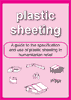 June 2007: Plastic sheeting 2007(600Kb) - english version:
|
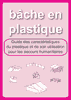 April 2008: Plastic sheeting 2007(600Kb) - french version:
|
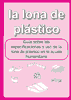 Oct 2007: Plastic sheeting 2007(600Kb) - spanish version:
|
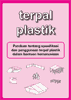 Dec 2007: Plastic sheeting 2007(1Mb) - bahasa indonesia version:
|
|
This guideline is aimed at helping humanitarian aid workers make more informed decisions on the use of plastic sheeting in emergencies. |
|
The target audience includes programme managers, field based engineers and technical staff, logisticians and others involved in providing emergency shelter and sanitation services to disaster and conflict affected families. |

|
|
Background top |
|
Plastic sheeting is one of the most widely distributed non–food relief items used in humanitarian operations. Each year, hundreds of thousands of square meters of polyethylene sheets are distributed by NGOs, government agencies and private sector. For families displaced by conflicts or whose homes have been damaged by disasters, plastic sheeting can be a useful temporary building material for repairs or emergency shelter structures. |
|
Ensuring that displaced families and communities receive the appropriate types of humanitarian aid in a timely manner is a key objective of all relief agencies and donors. The versatility and low cost of plastic sheeting have made it a default choice for emergency shelter interventions by agencies. Yet in recent disaster responses, variations in the sizes and quality of plastic sheeting distributed to displaced persons suggests a lack of clarity on how plastic sheeting can best support recovery efforts in affected households and their communities. |
|
As part of their organizational mandates to encourage more effective and coordinated humanitarian aid, The International Federation of the Red Cross and Red Crescent Societies (IFRC) and affiliate members of Oxfam International have collaborated on the production and distribution of these technical guidelines (above) on the specification and uses of plastic sheeting in emergencies. Informed by research into good practices in humanitarian responses where the timely delivery of plastic sheeting has been proven effective in meeting emergency shelter and sanitation needs, the contents of these guidelines have been reviewed by peer review panels in Europe, the UK and the US. Over 75 persons representing humanitarian agencies, donors, manufacturers, and independent consultants have contributed to draft versions of these guidelines. IFRC and Oxfam are extremely grateful for the valuable input these individuals have offered. |
|
Given the variety of local building practices and cultures where humanitarian interventions occur, these guidelines are not intended to be a definitive how-to guide for using plastic sheeting as a construction material. The key question that the authors, editors, and reviewers of these guidelines wish to ask is not “how to build a better shelter”, but “how to best support local recovery efforts while moving simultaneously towards more durable and dignified shelter solutions”. It is hoped that these guidelines will help decision makers and programme staff better understand how plastic sheeting can be useful in addressing this goal. |

|
|
Reference documents for download top |
|
project documents
|

|
|
|
see also
www.humanitariantimber.org for related work
contact: projects (at) plastic-sheeting.org
|